ReeferTechPro — expert diagnostics for the field.
A production multi-tenant web application built for transport refrigeration technicians. It combines hybrid retrieval over service manuals, AI-assisted diagnostics, a structured alarm-code database, and an automated document ingestion pipeline — bringing expert knowledge to the point of work.
- 1,200+
- Service manuals indexed
- 480+
- Alarm codes structured
- Multi-tenant
- Tenant fleets supported
Critical knowledge, locked in documents.
Transport refrigeration is unforgiving. When a reefer unit throws an alarm, the technician needs the right answer quickly — often in a yard, on a truck, with limited connectivity and downtime costing money by the minute.
That knowledge exists, but it's scattered across hundreds of PDF service manuals, scanned documents, and model-specific alarm tables. Finding the relevant page — let alone the right diagnostic step — means slow, manual searching that doesn't fit the pace of field work.
An answer engine built for technicians.
ReeferTechPro ingests service manuals into a searchable, answerable knowledge base. Technicians ask a question or enter an alarm code, and the system retrieves the relevant procedures using hybrid search, then explains the likely cause and next steps — always linked back to the source.
It's delivered as a multi-tenant platform, so each fleet gets its own isolated space, users, and documents — with an interface tuned for speed and real-world field conditions.
Everything a technician needs, in one place.
Hybrid RAG over service manuals
Combines keyword and semantic (vector) search so technicians find the right procedure fast — with answers grounded in and cited back to the source manuals.
AI-assisted diagnostics
Given an alarm code or symptom, the system suggests likely causes and next checks, explained in plain language and linked to supporting documentation.
Structured alarm-code database
A normalised database of fault and alarm codes across unit models — searchable, filterable, and consistently formatted for quick field reference.
Document ingestion pipeline
Uploads are parsed, OCR'd where needed, chunked, and embedded automatically — turning scanned PDFs and manuals into searchable, answerable knowledge.
Diagram & schematic support
Wiring diagrams and schematics are surfaced alongside relevant answers, so technicians see the visual reference, not just the text.
Multi-tenant fleets & users
Each fleet operates in an isolated tenant with its own users, documents, and access — with offline-friendly elements for spotty connectivity in the field.
A look inside the app.
Built for technicians in the field — fast, legible, and offline-friendly. A few of the core screens in action.
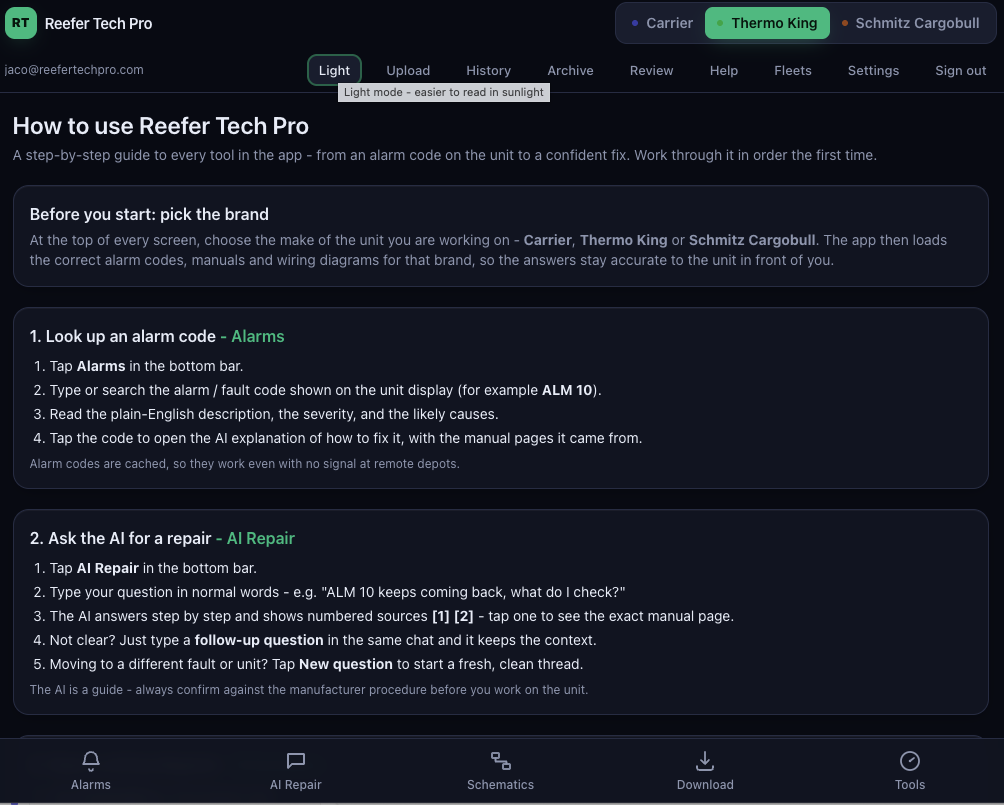
Main interface & guided workflow
Brand-aware home (Carrier, Thermo King, Schmitz Cargobull) that walks a technician from alarm code to a confident fix, with every tool one tap away.
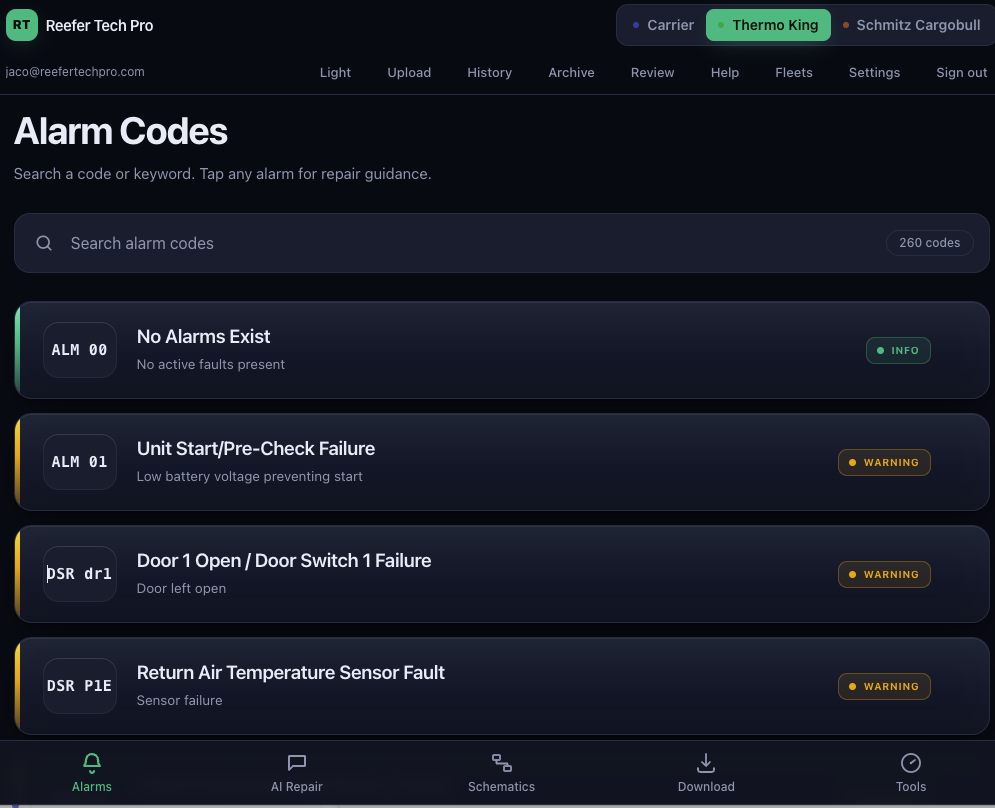
Alarm code lookup
Search 260+ alarm and fault codes with plain-English descriptions and severity, then open the AI explanation of how to fix each one.
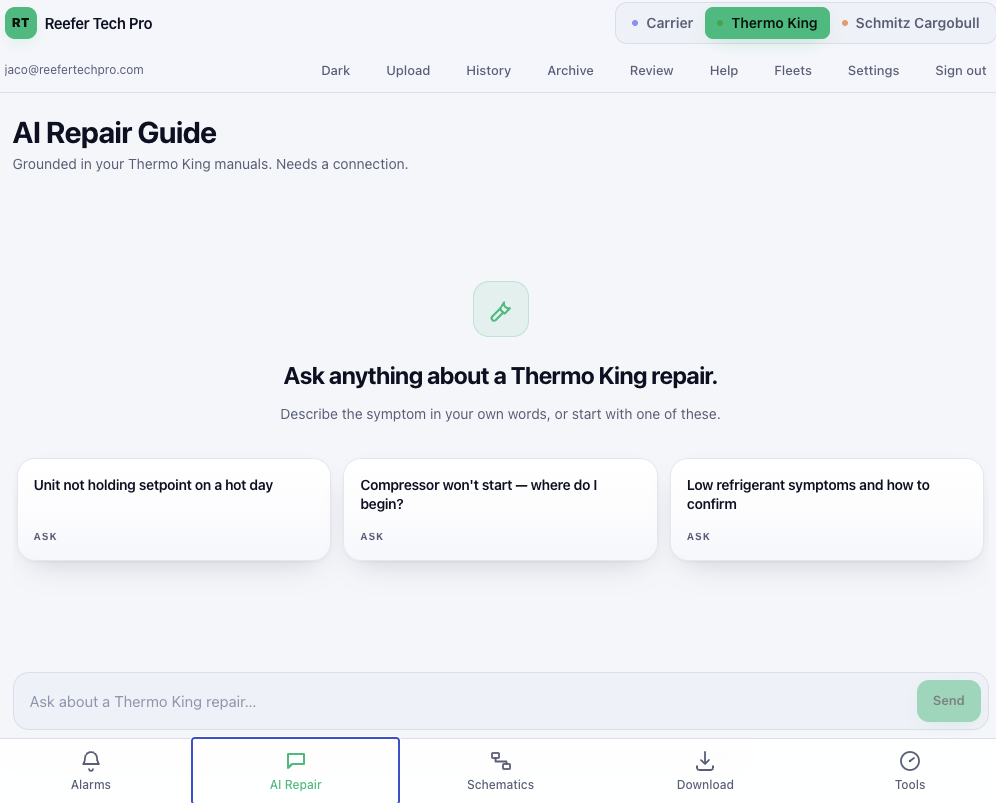
AI Repair — grounded answers
Ask a repair question in plain words. Hybrid RAG answers step by step from the unit's own manuals, citing the exact source pages.
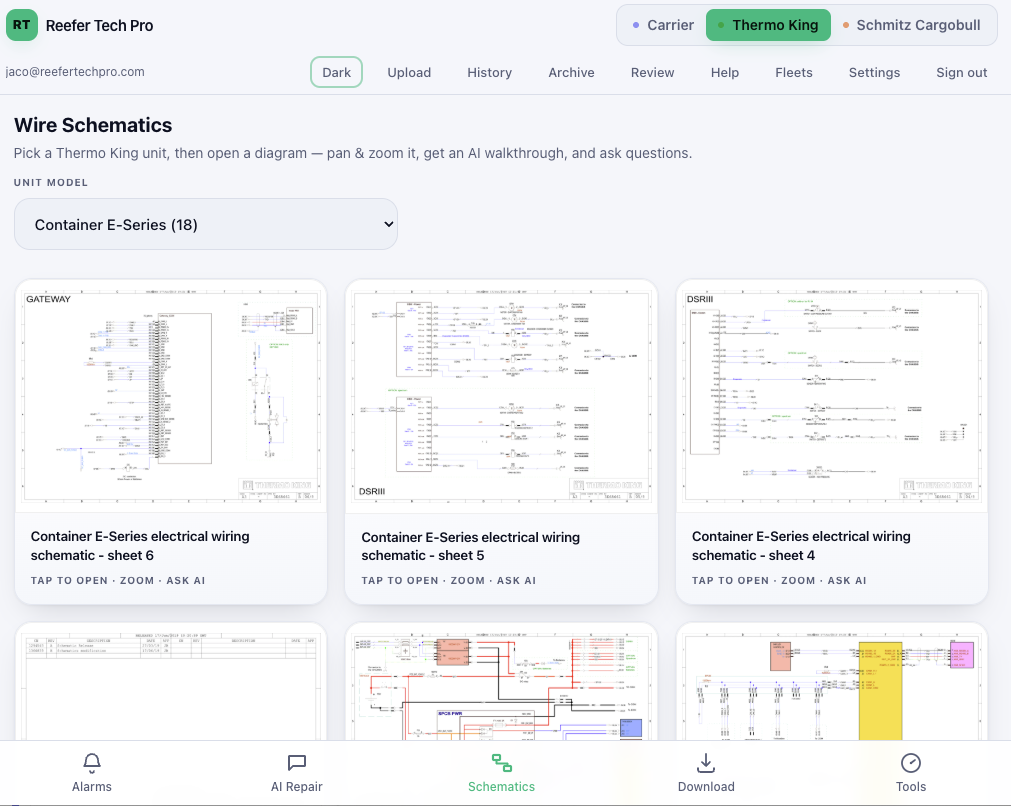
Wiring schematics viewer
Pick a unit model and open pannable, zoomable wiring diagrams — with an AI walkthrough you can question directly against the sheet.
How it's built.
A pragmatic, production-focused stack. Retrieval quality, tenant isolation, and a reliable ingestion pipeline drove the architecture — not novelty for its own sake.
Frontend
- Next.js (App Router)
- TypeScript
- Tailwind CSS
- React Server Components
Backend & data
- Node.js / API routes
- PostgreSQL
- pgvector
- Object storage
AI & retrieval
- Hybrid RAG (keyword + vector)
- LLM diagnostics
- Embeddings
- Re-ranking
Ingestion
- OCR pipeline
- PDF parsing
- Chunking & embedding
- Background jobs
Platform
- Multi-tenant architecture
- Role-based access
- Auth & sessions
- Observability
The hard parts — and how they were solved.
Trustworthy answers, not hallucinations
Challenge · Field technicians can't act on a confident-sounding guess. Answers had to be grounded and verifiable.
Approach · A hybrid retrieval layer (keyword + semantic) with source citations, so every answer traces back to a specific manual section the technician can open and confirm.
Messy, inconsistent source documents
Challenge · Service manuals arrive as scanned PDFs, mixed formats, and varying quality across manufacturers.
Approach · An ingestion pipeline with OCR, structure-aware parsing, and consistent chunking normalises everything into a clean, embeddable knowledge base.
Strict tenant isolation at scale
Challenge · Multiple fleets share the platform but must never see each other's documents, users, or data.
Approach · Tenant-scoped data access enforced end to end — from queries to retrieval — so isolation holds even inside the RAG layer.
Real-world field conditions
Challenge · Technicians work in yards and workshops with unreliable connectivity and no time to fight software.
Approach · A fast, focused interface with offline-friendly elements and short paths to the most common tasks: look up a code, diagnose, find the diagram.
Outcomes.
ReeferTechPro moved from concept to a production platform that changes how technicians access knowledge in the field.
- Turned static, hard-to-search manuals into an answerable knowledge base technicians actually use.
- Reduced time-to-answer for alarm codes and diagnostics from manual page-flipping to seconds.
- Established a repeatable ingestion pipeline so new manuals and fleets can be onboarded without rework.
- Delivered a production multi-tenant platform ready to grow across additional fleets and unit models.
Technologies used
Interested in a similar project?
If you have a technical domain full of knowledge locked in documents — or a multi-tenant product that needs real AI, done credibly — let's talk about building it.